
We sell the best above ground pools and equipment from our 25+ year experience to make pool ownership as easy as possible however…
A Pool is Still Work!
We are happy to help you with questions, water chemistry, and operations of the equipment we sell. please refer to this tutorial and text us if there are any questions not answered here
PLEASE CONTACT OUR INSTALLER TONY FOR OPENINGS & CLOSINGS AT 412-609-5764
Chlorinate and Backwash!
These 2 things solve 90% of your issues!
Caring for your pool the way we teach is the easiest way to maintain an in-ground pool.
- Chlorine: (from a Salt System/Tablets/Shock) sanitizes your water and keeps it clear. see about Salt Water below
- Backwash (or Disassemble & Clean): Keeping your filter clean allows water to flow. A clogged filter leads to high pressure & low water flow, and then heaters and salt generators stop working.
We recommend and sell Diatomaceous Earth (DE) Filters because they filter 5 TIMES BETTER than Cartridge Filters and are easier to clean and cheaper to maintain.
Single backwash (whenever needed)
- Turn OFF Pump
- Turn Valves OFF to the Pool
- Hook up a backwash hose to the Bottom Fitting on the Filter
- Bump the handle 4-5 times to release DE powder from Filter
- OPEN the Pressure Release Valve
- OPEN the Backwash Valve to release water using gravity to drain the tank
- CLOSE the Pressure Valve and Backwash Valve
- OPEN the Pool Valves
- Restart Pump
- That’s It! If you see good water flow at the pool
full backwash (a full clean)
Exactly the same as a Short Backwash except you REPEAT this cycle 4-5 times until water coming out of the backwash hose is clear – ALL the White Powder is removed from the Filter (the Diatomaceous Earth aka DE). You then have to RECOAT the Filter with DE. We have found it is best to GO LOWER than what is recommended on the filter sticker when adding back DE powder. Too much DE can clog and limit the flow!
disassemble and clean (1-2 times per season)
Unless you have a major issue (phosphates, algae, etc) or a very dirty pool, you should only have to take apart the filter AT MOST a couple times per season. Remove the clamp and pull out the entire filter, clean, degrease, and reassemble. Recoat the grid with the recommended amount of DE.
Balance the Water Weekly!
Proper Chemistry is key!
Inexpensive test strips will tell you 90% of what you need to know. We can further test your water for free, if needed, or use a monitor such as a pHin to have your pool notify you. Focus on keeping chlorine and alkalinity within proper range, and adjust pH from there.
Chlorine – Apply Liberally!
A Shock Never Hurts
Shocking increases the sanitizer level temporarily to oxidize and kill algae or bacteria and clear the water (OR you can use the Super-chlorinate function on your salt system). You can do this weekly (works best in the evening) or whenever you have lots of swimming or a dirty event (bad rain, pool contaminants, etc). Typically, shock is a high level of some form of chlorine, but can also be a non-chlorine shock. We recommend Zappit or a similar high percent calcium hypochlorite.
TIP: Utilizing the RECIRCULATE function on the valve is a great way to add chemicals to the skimmer and evenly distribute into the pool without going thru the filter. Just remember to put it back to FILTER once dispersed and run for a couple hours to fully circulate.
About Salt Water
It’s still Chlorine!
As mentioned above, a Salt Water Pool is still a chlorine pool, but the chlorine is generated from Pool Salt in the water. Your water tends to be softer and it is less expensive and easier overall than buying and handling chlorine. Salt systems typically pay for themselves in the first couple seasons. We highly recommend them, but for them to work, you need:
- Proper Salt Level ( 2700-3400 ppm)
- Proper Flow (Backwash as explained above!)
- A properly sized and functioning Generator/Cell
Salt levels are typically indicated on your equipment. The salt level can also be tested with strips (or with a professional meter) to make sure the system is accurate. ALWAYS ESTIMATE LOWER when adding salt.
If your salt is too high, you can damage equipment and the only way to bring it down is to drain water and replace it with fresh water to dilute!
Check Your Cell
Cell cleaning frequency will be dependent on several factors, especially pH and Calcium Hardness. Calcium buildup (or scale,) is the most common in a salt chlorinated pool. Typically, you will JUST RESET the notification, because our equipment is oversized, and build up will be very minimal. If you do need it cleaned, we recommend a service call.
If you want to clean it yourself, you can follow these steps:
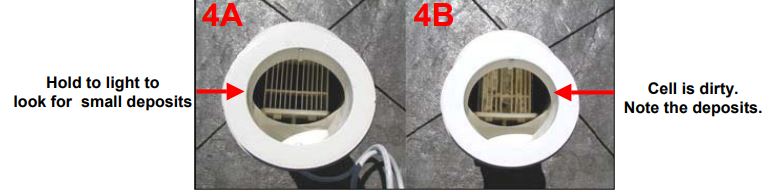
- Turn off the power to the system and deactivate the pool pump before removing the Turbo Cell.
- Remove the Turbo Cell. Once removed, look through the cell and inspect for scale formation (light colored crusty or flaky deposits) on the plates and for debris that is caught on the plates. If no deposits are visible, reinstall the cell.
- If deposits are seen, use a high pressure garden hose to flush the scale off.
- If a high pressure hose does not remove the majority of deposits, then use a mild acid wash. Be sure to wear rubber gloves and appropriate eye protection. In a clean plastic container, mix a 4:1 solution of water to muriatic acid (one gallon of water to one quart of acid).
Caution: ALWAYS ADD ACID TO WATER – NEVER ADD WATER TO ACID. - Fasten the Turbo Cell to Cell Cleaning Stand with the cord side down. Before filling Turbo Cell with muriatic acid solution, place a container underneath to avoid any spills. Fill the Turbo Cell to the top with the solution and let soak for 15 minutes. Empty the Turbo Cell and inspect. If clean, rinse with hose and reinstall. If there are still deposits after soaking, repeat the soaking procedure until clean. The water/muriatic acid mixture can be stored for later use or it can be disposed of. Follow the chemical manufacturer’s recommendations when storing or disposing the water/acid solution.
- Reinstall the Turbo Cell. Press the small diagnostic button next to the display for 3 seconds to stop the flashing Inspect Cell LED and reset the countdown timer for another 500 operational hours.
Heating the Pool
You Need Water Flow
Quite often the reason a heater will not heat is poor water flow. Enough water has to be moving through the system or pool heaters will throw an error.
Controlling with Automation
Most heaters hookup with a simple 2 wire connection. The automation controller takes over turning on and off the heater by a very simple ‘Heat’ or ‘No Heat’ type of control. If there is a problem at the heater itself, the system will not know. It will ask for heat, but the heater will simply not heat the water. If your pool seems to not be heating:
- Check that the Heater is on and has power
- Check Proper Flow (Backwash as explained above!)
- Check that the Heater is set to ‘Remote’ or ‘External’ Control
